
Keeping clients' computers safe and profitable for over 30 years
Home Forms About Current Newsletter subscribe

Understanding AI and ourselves
|
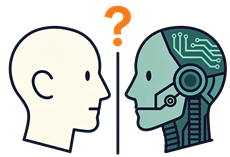 |
We are also a kind of neural network. I'm filled with millions of ideas. Many things I think are true are just false memories. Also, many things are false thinking or things I've heard and believed but aren't considered true anymore. Furthermore, many things now considered true will be proven false sometime.
So, if I'm asked a question, I sometimes have an answer I think is true. But, honestly, I haven't looked at it, verified it, considered the source, tested it, and so forth. If I were asked if I'd bet my home on that factoid being true, I don't think I would. But, if you ask me, I'll just tell you the answer and won't bother to spend an hour or even 5 minutes trying to verify it. This is not just human; it is also how AI models function.
We should not believe an answer just because it comes from a computer. They are not always right. In the same way, we can't assume we are right all the time, or some talking head giving us news on TV is right all the time. We can't even assume experts are always right or politicians are always wrong.
When we are asked something, we determine how to respond. Perhaps we think we know the answer and just respond. However, if the stakes were higher, if it were more important, if the wrong answer would be expensive, then we might be more careful. Instead of just answering, we might look at the answer and determine if we think it could be wrong. This extra step, looking at our ideas and wondering if they might be wrong and how they might be wrong, takes energy. Normally we just don't think it is worth it. At this point, we are not expending lots of energy; we are just trying to determine if it might be worthwhile to check the idea.
If the question's answer was worth checking to determine if our answer might not be true, and we determine that it might not be true. Maybe there is a 10% chance it is wrong. Now, we have the problem: Is it worth the effort, the energy expenditure, to do the research and figure it out? Perhaps or perhaps not.
The issue is, that if we do the research, and we check numerous sources, then should we accept what those sources say? They are just like us. They present an answer. What is the chance it is wrong? Is it worth verifying? This can spiral infinitely. This is obvious if it is a political question. If our answer is preferred by one side, and we check that side's sources only, we are most likely going to find our ideas supported. But if we checked the other side's experts, we'd find our ideas refuted.
Can we can ever really know? At what point do we decide to stop doing more and more research and thinking, using more and more energy and taking more and more time, and just present our best guess? Eventually we decide to stop. So, it looks like this:
- We are asked a question
- We have an answer that seems right
- We can present the answer or analyze it. If we choose to analyze it, we need to use energy to determine if it might be wrong.
- If it might be wrong, we have to decide if it is worth the energy to research it.
- If we research it, at each point of the research, we can again examine what we are getting and check if it might be wrong.
- This process in step 5 can repeat over and over but must stop somewhere.
- At some point (between steps 2 and 6 above), we decide we've spent enough time and effort and give the answer.
This is precisely how we act. It is also how an AI model acts. It was trained and read somewhere something that seems to be a good answer, but who knows? Or, it can generate a new answer that seems plausible. Now, should it spend the energy to check and determine whether its analysis might be wrong or inappropriate given the surrounding circumstances? When we do this, the energy is work (compute cycles). When a bot does it, the energy, and compute cycles cost the owner money. How much of the owner's money should it spend?
So, you see that the AI model is presented with the same dilemma we have. How much compute power should we use to verify the correctness of some answer? More work and better reliability or less work and a greater chance of inaccuracy? What shall it be?
Often people complain that the bots don't give correct answers. If we asked a person, they could also be wrong. Nature Magazine did a study of science articles in the Encyclopedia Britannica and found an average of four errors per article. At least I've read that. Is it true? It isn't worth my time and effort to find out. It proves my point, so I want it to be true. Also, many studies have been done of newspaper articles, and they verify that about 50% of those articles have errors in them. Again, I remember having read this, and I use that memory to prove my point. Bots get information from sources that aren't reliable. They have to decide whether to verify an answer and how much verification is warranted.
Costs
There are a few costs in computing answers. We've discussed the cost of compute energy. But there is also the cost of time. The longer the user has to wait for an answer, the more likely he is to go elsewhere in the future and the less likely it is to feel like a chat.
So the costs are time, money, and energy. The money could be from the user or the company that supplies the bot. Perhaps the longer the answer, the more the provider will make because they can charge the user more. Or perhaps they are on a plan that doesn't charge the user for each item, so the provider is paying and wants to keep his costs down. Everyone wants faster answers.
One of my favorite bots is Grok-4.1-Fast-Reasoning. It is fast and doesn't search the web or think much. It just uses what it has already learned. I use it when I don't need current information and don't think it is likely to have incorrect information because the facts are clear. For instance, I wanted quick, short information about how money was authorized and printed in colonial America. Total cost: 14 points, or what location a particular phone number area code is associated with: 4 points.
Another favorite bot I like is GPT-5.6-Terra. I asked it about whether categories and tags were exported by EPIM when they did EML exports. That cost 2,241 points. It did web searches and checked itself a few times and checked answers its search found. Terra isn't a high-level bot, just a mid-level one. But Terra is more likely to give me correct answers for complex questions than Grok-4.1-Fast-Reasoning. It also costs much more.
Multiple checks
You might ask more than one doctor for a medical opinion or more than one roofer for a price on a new roof or even how it should be done. Want to buy a new car? I suggest you check with more than one car review. It is the same with these bots. One of the big advantages of a hub like Poe is that you can have a second (or third) bot join a discussion you are having. Yesterday I asked Claude Sonnet about the history of the Junto club started by Benjamin Franklin. Then asked GPT-Terra to review the answer and address any problems and add anything important that was missed. It is twice as expensive to have two bots, but occasionally you get more out of a discussion when more than one bot is involved with you.
Summary
You should not just accept anything anyone tells you as true, or even anything you remember as true or figure is true. Most of what you think is true could be false. Most of what we hear or read could be wrong. Just because it comes from a bot, "expert”, government, or doctor doesn't make it true. Be skeptical and try to probe the answer to find possible flaws. If you are dealing with a person or a bot, bring in a bot (or another one), and have it join the discussion.
Bots can access huge amounts of information and process it lightning fast. That doesn't make their answers true any more than what you read in the newspaper or see on the news is to be blindly accepted as true.
The huge advantage that the bots have is that you can engage with them. When they give an opinion about something in the news, you can question it. You can ask for support. You can ask why they believe something. Bots don't take offense. Generally they don't get defensive. They sit back and reason with you to understand something together.

This article is licensed under a Creative Commons Attribution-NoDerivs 3.0 Unported License.