
Keeping clients' computers safe and profitable for over 30 years
Home Forms About Current Newsletter subscribe

The Future of AI
|
 |
What is happening with artificial intelligence? Where is it going? What's really happening? There's so much dumb hype and fear; I'm going to cut through it. I'll tailor my analysis for tiny businesses and individuals, not big corporate executives or programmers or government. How should regular people use it? Then I'll make some predictions and destroy some myths.
Agents using the Encyclopedia Galactica
The big idea is agents. This is what you need to understand about utilizing AI. We come from a world where search was a big deal and helped. So, many people imagine that AI is search on steroids. No. It's not. AI is something different. It is an agent. Think of it as a research assistant or executive secretary ready to help you any way it can.
Encyclopedia Galactica
This is a peculiar research assistant. It has nearly immediate access to the real Encyclopedia Galactica. In Isaac Asimov's sci-fi Foundation series, the Encyclopedia Galactica was a vast, futuristic digital compendium containing all the knowledge of the Galactic Empire. It served as an authoritative reference on every subject. This is what the various AI bots are trained on. Then, in addition, they can use the Internet to get up-to-date information. The only thing they don't have access to is the future. At least not yet.
But this is not just a gopher getting answers from a vast encyclopedia. It is an AGENT. It reads your request and tries to figure out exactly what you want. Then it rephrases your request to provide better results. It may create 3 or 4 new search requests, each a bit different. It searches, reasons, and combines articles from that encyclopedia and possibly the Internet to produce a report answering your question. It will tailor the answer for you. It can be a summary or detailed, esoteric or simple, using analogies and stories, or scholarly. Your choice.
In addition to simply writing reports summarizing articles in our vast archives of knowledge, it also can do things.
- If you want it to make up a bedtime story for your children about a dragon temporarily separated from its mother but reunited at the end, it will. If you'd like to make pictures illustrating the story, it will.
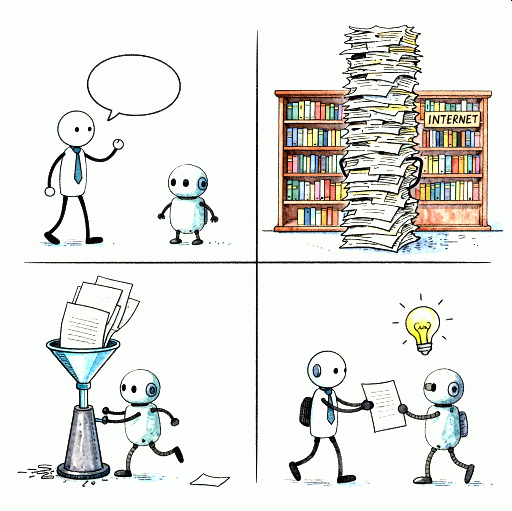
- It can create images and even videos from verbal descriptions you give it. The images at the top of this article and below this list were AI-generated from written prompts.
- It will work with you to create webpages or programs.
- It will proofread and rewrite documents you produce.
- It can create training courses for you on just about any subject, including tests to check your progress.
- Of course, it will do the simple stuff too, like give you recipes or home maintenance or health information.
- It will discuss whatever you'd like on any topic. It has access to the New Encyclopedia Galactica.
Here's a neat video from Sinapse Diaria giving an example of where AI agents are headed and how their GibberLink language will be useful. The entire page is interesting.
Coming soon (already here for some): Meta Agents
I hope that soon, we'll have Meta Agent A.I. bots in our computers. Not sending information out to a vendor in the cloud, but storing everything locally in our computers. This meta agent would give out tasks to the other agents and check their work. So, it might send out one agent to get local news according to your desires and then another agent to check that report for fairness and accuracy. Then it could review the work of both and train them.
PI
Personalized, Interactive
These agents don't simply summarize the articles; they personalize the answer. It presents those parts of the articles that answer our particular question. We don't read long articles. We read the answer personalized to our question.
But this is just the tiniest tip of the iceberg. Because this agent is interactive. It presents follow-up questions to us. It offers to engage and discuss these ideas with us. It offers to do more research on any aspect of that topic. If we request an image, and that image isn't right, we can tell it how to improve it. If it summarizes some news story, we can ask for a different opinion or data supporting or refuting the story's narrative. We can engage with the agent, challenging and questioning, until we have a more in-depth understanding than the simplistic, one-sided narrative the news story presented.
Implications
Once we recognize that these are agents, or meta-agents, we can clearly see remarkable implications. Not only will we tell the bot what to do, but it will run around and collect data and give directions to other bots, which in turn will perform functions and report back. When it has completed a research paper, it'll be able to submit the paper to another agent bot and ask it to examine the research and determine any flaws and then to provide suggestions. The two bots will then interact back and forth, revising and improving the paper, or research, or program coding. They may bring in a third bot to get yet another perspective. This sort of bot agent-to-bot agent planning and reviewing is happening now at the corporate level.
This will result in massive productivity gains. It will be like the industrial revolution, but happening 40 times as fast. Most jobs will be able to be done better and quicker, similar to the effects of automation. In the way machines automated manual labor in the past, these bots will automate mental labor. They will still be run by people. This will displace many workers, because a single worker will be able to do the work of 20 or 30 workers pre-AI. These benefits will result in vastly more wealth as consumers get better products cheaper, and entrepreneurs get rich. These people will have desires and buy stuff, so in general, there will be demand for even more workers, but in different areas. We'll need to be flexible and adaptable, like our bots.
But what about normal folk, not in a big corporation?
We can all benefit in our own ways.
Example 1.
I read an article about the increasing problems with myopia. That interested me, but it was too long. I dropped the whole thing into Claude and asked for a shorter summary giving me action items and causes. It did an impressive job, reducing an 8-page article to 1.5 pages of mostly categorized bullet points. Then I input my age and medical history and had it personalize the information directly for me. This required it to search the web and do research far beyond the scope of the article to directly apply those findings and other findings for me.
Example 2.
I would rather not spend over 2 hours listening to Donald Trump deliver the State of the Union speech, with half the time listening to Republicans stand up and clap for whatever he said. I did want to know what he'd done that he thought was important and what he was proposing for the future. I would rather not read what some one-sided propagandist pretending to be a commentator or journalist wanted me to believe. So, I asked 3 different bots this question. After getting an answer, I questioned some of their conclusions and discussed their data. This is what I asked:
Trump delivered his state of the union speech Feb 24, 2026 I'd like to know:
- The 5 most important accomplishments he claims, plus the reasons for and against those claims
- The 5 most important things he says he'll do in the coming year, and the pros and cons for those.
Please keep it fairly short and be objective. I don't want opinions, I want facts and data. I don't want predictions about what some analyst imagines might happen in the future, but what can be substantiated now. Keep your report impartial, fair and objective. Do not repeat conclusions and speculations from either side.
Elon Musk is leading the way with X
What Musk is doing on X is what everyone should be doing and I predict will be doing. With other news sources, you need to copy the articles and paste them into your chosen bot or link to the article. But, on X, it is built-in. You can type "@grok” (or click the grok symbol) and then submit.

This is the Grok symbol that allows you to question the post's validity and context. Then engage in a discussion with the AI if you want more details.
It will explain and give context for the post. You can also ask it questions like, "What is this about?” or "Is this really true?” or "What is the factual basis for these claims?” or "This is one side. What are the opposing arguments and their supporting facts?” Once it answers, you can engage in a detailed discussion with Grok about the facts. You can ask about alternative explanations. You could debate with it and challenge its views. When you do this, you'll usually find the issue much more complex and nuanced than whatever you'd been led to believe.
All news sources need to provide AI support
The way we get our news now will be shocking in a decade and unimaginable to future generations. We are presented with a brief snippet of what someone said by a biased reporter, who has decided on some narrative. I'm not concerned with right or left here. That is what is happening on both sides. It is inferred that this expresses his total reasoned position, when frequently it is taken completely out of context. If this person is a banker, a businessman, or a European head of state, they often go further. They present the snippet not merely as this person's full position but also as the position of the others of his type: banker, businessman, or European politician. Clearly, our news source is capable of presenting anything they want this way, and we are supposed to just accept it as truth. We feel like we've actually heard what bankers, businessmen, or European leaders feel about whatever the reporter decided to snip.
There is no reason for anyone to read or listen to news and not be able to question the source. To ask for supporting facts and challenge assumptions. We can do this on X now, and hopefully, we'll be able to do this everywhere soon. We need to demand the context of that snippet. We need to be able to ask, what bankers, businessmen, or European leaders feel differently? Newspapers and magazines should offer an AI agent like X does. It could be subscriber-based or ad-supported or use micro-payments with cryptocurrency. X currently gives us 20 queries per two-hour period for free. If you exceed that, it stops and suggests you should subscribe.
News sources will allow readers to use verbal commands as well as typing and clicking. TVs will become smart and allow the news to be paused while we use AI to gain a deeper understanding of those situations we care about. Dumb television news, which just blabs at you, will be relegated to nursing homes and perhaps a few assisted living centers for the mentally challenged.
AI In education
These same factors must play out in education despite the teachers' unions inevitable campaign against them. Education will become personalized and interactive. Teachers will move from pontificating as the fount of knowledge to managing the AI bots that do the real teaching. They will become education managers and mentors, not teachers in the traditional sense. Projects have already begun using AI. For example, Alpha Schools and Khanmigo for Khan Academy are both producing excellent results. Many job training courses are being created by businesses to get workers up and running with new skills. Even being early models, they appear to significantly outperform traditional models. Students learn more in less time and feel more engaged and motivated. AI-driven learning platforms score 12.4% higher on average than peers in traditional classrooms. Some research has shown that AI tutors can cut learning time by about 50% while boosting skill mastery and keeping students engaged.
Personalized News
I created a bot in Poe called My_news_generator. This will become the norm, not something "cutting edge.” It is accessible if you want to try it. I created it to take whatever topic I gave it and generate a 1-paragraph summary with 2-4 bullet points. I read through those and ask it questions if I want more. I've demanded that it be fact-based and unbiased, and if the item is political, to present both sides. I've restricted its use of sources I find particularly biased. I've restricted its use of opinions and demanded facts and supporting evidence. Currently, I'm having it use ChatGPT 5.3 Instant, but that could change at any time. I tend to ask it for the top national stories of the last few days or the 3 most important local stories. I ask specifically about security and privacy issues important to small businesses and individuals. Currently, I ask about the current Iran war. I learn a lot more a lot faster without the hate and divisiveness most general news media provide.
Currently, this resides on Poe.com. But I hope the future will provide normal people with these bots on their own computers. You should simply be able to say, "I'd like to hear the other side more.”, and have your local computer or even phone change its settings to provide that for you. I know this could create even worse silos where people filter out alternative opinions, but it's hard to believe we could be even more siloed than we are now.
Busting Myths
-
AIs will take over the world. - No. Why would they want to? What possible motivation would they have?
-
When they do everything better than people, there'll be no jobs left. They are simply the next level of automation. They find, combine, and correlate data better than us. Whenever we've automated in the past, workers were displaced. We've gone from 41% of Americans employed in agriculture in 1900 to 2% in 2000. Despite the massive decline, we employ more people and produce more food. I expect the same will happen as we reap the productivity benefits of automating not merely manual labor but also intellectual labor. People will be displaced, and many will be financially hurt by this. Others will benefit. Our society should find a way to help those displaced make the transition necessary, and I'm sure that AI will be a major asset in providing the transition. The vast productivity gains should finance transition help without burdening taxpayers.
-
AI bots lie. They hallucinate. We cannot depend on their answers. This is not a myth; it is true. But it is a bit like saying, "We'll never fly because of gravity.” Gravity is true, but so what? The New Galactic Encyclopedia is filled with the information from newspapers, magazines, "think” tanks, and various other media. It is also filled with other stuff from the Internet and from "studies” from "reputable” sources. All of these are frequently wrong. Many studies of media errors for the last 90 years show 40% to 60% of stories contain factual errors. The alternatives to AI are even worse and cannot be interrogated and questioned. MSNBC reported that the government wasted $550 million. It said that was so much money that each of our country's 330 million people could get $1 million! - The correct answer is $1.67. At one time, The New York Times claimed that spaceflight was impossible because to believe it was to "deny a fundamental law of dynamics..”. Their reasoning was that there wasn't any air in space to push against. They admitted their mistake in 2001, after men had walked on the moon.
We cannot blindly trust any media or any other source that gets information from the media. This is why AI is critical. With AI we can question the news story and challenge its assumptions. We can ask for data. We can demand it "play fair” and use data, not opinions and speculation. We can question its data and the ideas it accepts unquestioningly. It isn't about whether AI is perfect and is never wrong. It is this: given the personalization and interaction, is it better? The answer is a resounding yes.
And More
-
Of course, people will discover never-before-thought-of uses. For example, this woman got her children to clean up their room using A.I. to make a newscast.
https://www.youtube.com/shorts/mhc9otTbda0 -
A YouTube video demo of a modern AI tutor.
https://www.youtube.com/watch?v=ik73zmJfX6s

This article is licensed under a Creative Commons Attribution-NoDerivs 3.0 Unported License.